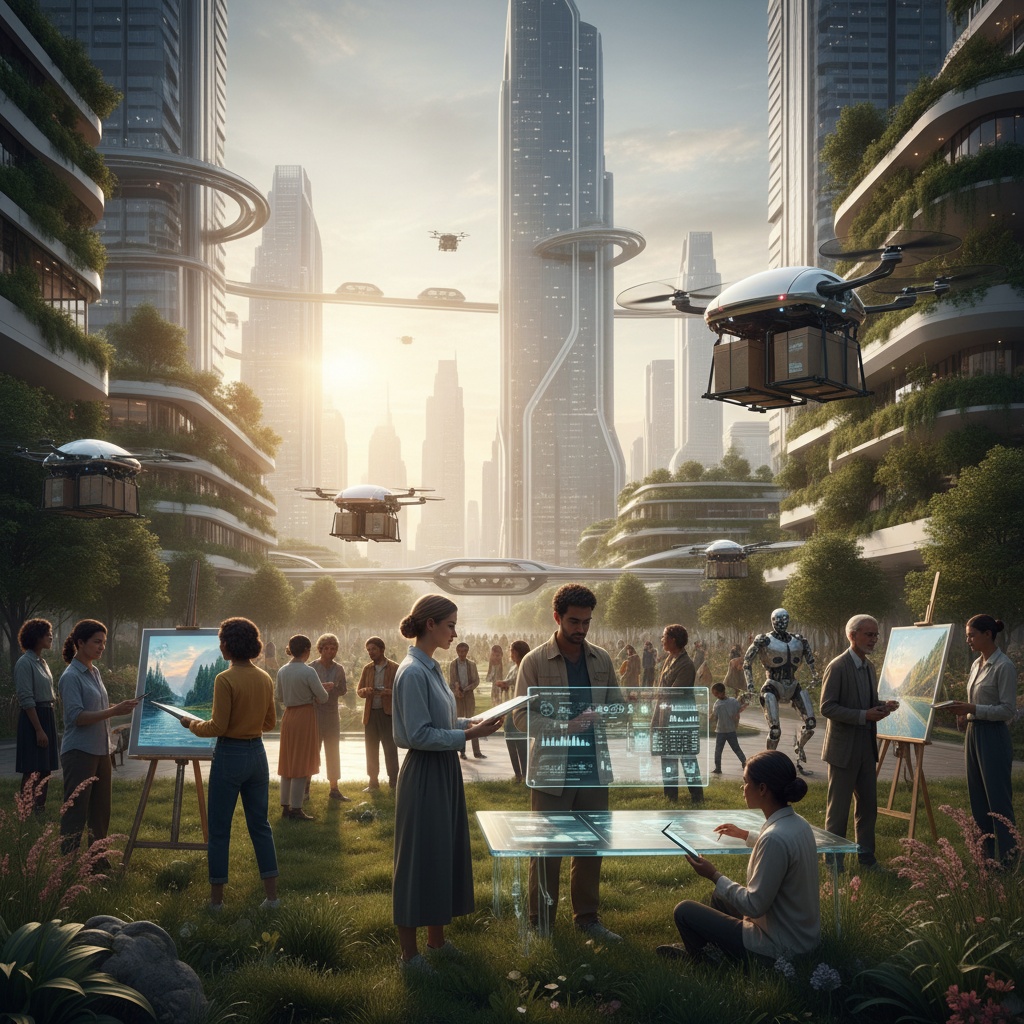
The 2030’s 99% Unemployment Revolution: How AI and Automation Will Reshape Society
Imagine waking up in 2035 to realize that nearly every task you once thought required human effort is now handled by machines—doctors diagnosing illnesses, robots constructing homes, algorithms writing code, and even AI assisting in government decision-making. This is the reality projected by the 2030’s 99% Unemployment Revolution, a paradigm shift where technology achieves such unprecedented efficiency that human labor is almost entirely removed from the traditional economy.
While this vision sounds like science fiction, it’s steadily becoming science fact. Artificial intelligence, robotics, and quantum computing are advancing at exponential rates, and by the 2030s we could see a world where machines perform 99% of jobs faster, cheaper, and better than humans. The promise? Freedom from mundane labor and the possibility of a flourishing post-work society. The peril? Economic upheaval, inequality, and existential identity crises for billions of people.
The big question is not if this automation wave will arrive, but how humanity will respond. Can we build systems that ensure widespread prosperity instead of deep division? Can governments, businesses, and individuals shift from old models of labor-based worth to new definitions of meaning and wealth? Let’s explore how the 2030s could shape a world both liberating and challenging, ushering in the future of work 2030 and beyond.
Understanding the 99% Unemployment Revolution
To grasp this concept, we first need to define what 99% unemployment actually means. It does not suggest that humans will be incapable of working—it means that almost all traditional jobs will be more efficiently performed by machines, leaving only niche roles for human labor.
Historical Context
Technological unemployment is not new. From the Luddites protesting weaving machines during the Industrial Revolution to the digitization wave of the late 20th century, machinery has historically displaced workers while also creating new roles. What makes the 2030s unique is the scale and speed of displacement.
Key Drivers and Timeline
- Advancements in machine learning and AI decision-making.
- Robotics that outperform human dexterity and strength.
- The rise of quantum computing, accelerating problem-solving capabilities.
Analysts project that by the mid-2030s, most industries could operate autonomously, resulting in technological job displacement on an unprecedented scale (Source: nber.org).
The Root Causes: AI and Automation’s Rise
The engine driving this revolution is rapid advancement in AI and automation technologies, paired with relentless economic pressures to improve efficiency.
Technological Forces
AI systems now mimic human cognition, learning from data, identifying patterns, and even making complex decisions. In fields like healthcare, AI already outperforms humans in diagnostics, while in logistics, fully automated supply chains are becoming reality.
Economic Pressures
- Corporations are incentivized to cut costs, pushing adoption of automation.
- Digital tools reduce error and increase speed, maximizing productivity.
- Competitive markets demand efficiency, further fueling AI integration.
Industries from manufacturing to services have already begun this shift. For instance, robotic surgeries and AI-driven chatbots are commonplace today, offering a glimpse into what full automation could look like (Source: bls.gov).
Societal Impacts: From Inequality to Identity Crisis
While technological marvels may free us from work, they also bring social challenges.
The Inequality Dilemma
Capital owners who control automation technology stand to gain enormous wealth, while displaced workers may face economic precarity. This widening gap could destabilize societies.
Human Identity and Purpose
- Loss of purpose from the end of work-driven identity.
- Rising mental health struggles linked to redundancy.
- The potential emergence of alternative communities building value outside of work.
The 99% unemployment era forces us to redefine meaning beyond employment—an existential challenge as much as an economic one.
Economic Repercussions: Rethinking Wealth Distribution
With machines doing the work, how will economies adapt when wages are no longer the main driver of consumption?
New Economic Models
- Collapse of traditional GDP models based on labor output.
- Adoption of universal basic income (UBI) as a stabilizer.
- Transition from labor-based to asset-based wealth structures.
Opportunities and Entrepreneurship
Ironically, niche industries could thrive—ethics advisory services, arts, culture, and human-centric innovation may become highly valued. The challenge is building systems to sustain people until these industries fully evolve (Source: oecd.org).
Policy Responses: Governments and Global Solutions
As national and international leaders anticipate mass automation, policy innovation becomes essential.
Government Action
- Implementation of UBI schemes.
- Reskilling and retraining initiatives focused on creative and ethical fields.
Global Collaboration
Governments must cooperate on AI ethics, taxation of automation, and universal rights in a post-work society. Countries like Finland and Canada already test automation-focused UBI pilots, providing valuable case studies for scalability.
Opportunities in a Post-Work World
While the disruptions sound daunting, the future might also be bright.
Human Flourishing Beyond Work
- Explosion in creative pursuits as humans are freed from economic survival pressures.
- New opportunities to pursue education, personal growth, and cultural enrichment.
Sustainable and Collaborative Future
Entire industries focusing on sustainability and human-AI collaboration may emerge, rebalancing technology with ecological and social well-being. This could herald a renaissance in human creativity and global cooperation.
Preparing for the Revolution: Steps You Can Take Today
How can individuals and businesses stay resilient amid sweeping change?
For Individuals
- Upskill in AI-resilient areas: creativity, ethics, innovation.
- Build financial resilience via smart investments and diverse side incomes.
For Businesses
- Invest in technologies that augment, not just replace, human effort.
- Support worker transition programs and advocate for fair policy reforms.
FAQ: The 2030’s 99% Unemployment Revolution
Q: What is the 2030’s 99% Unemployment Revolution?
A: It’s a projected future scenario where automation technologies can perform nearly all traditional jobs, rendering human labor largely unnecessary. This revolution could transform economies, societies, and individual identities.
Q: How will AI cause 99% unemployment by the 2030s?
A: Advancements in AI, robotics, and quantum computing may allow machines to outperform humans in nearly every field. As companies adopt these tools to cut costs and increase efficiency, human employment demand drops sharply.
Q: What are the potential benefits of mass unemployment?
A: Freed from labor, humans may gain time for creativity, education, leisure, and community development. Rather than surviving to work, society could evolve toward flourishing in a post-work economy focused on meaning.
Q: How can governments prevent chaos from widespread job loss?
A: Through policies like universal basic income, reskilling programs, and AI regulation, governments can stabilize economies and protect social welfare during the transition.
Q: What steps should individuals take to prepare for this future?
A: Individuals should focus on upskilling in AI-resistant fields, building financial resilience, and engaging in civic advocacy for fair policy changes to ensure equitable futures.
Conclusion
The 2030’s 99% Unemployment Revolution could be the greatest disruption—and opportunity—our species has ever faced. As machines assume nearly all work, we’ll confront an existential choice: allow inequality and unrest to grow, or reinvent humanity around creativity, sustainability, and collaboration. This shift invites us to free ourselves not only from labor but also from outdated ideas of value and success. By preparing today—through proactive policies, continuous education, and personal adaptation—we can shape a future where technological job displacement leads not to despair but to a fairer, more fulfilling post-work society. The revolution is inevitable; how we respond will define the century.
Leave a Reply